
A clear visitor register format saves time at reception, keeps visitor records easy to find, and helps any office, school, factory, hospital or housing society know who visited, whom they met, and when they left. If your front desk still uses loose sheets or a notebook with no headings, this guide will help you set up one consistent format and use it every day.
WHAT IS A VISITOR REGISTER?
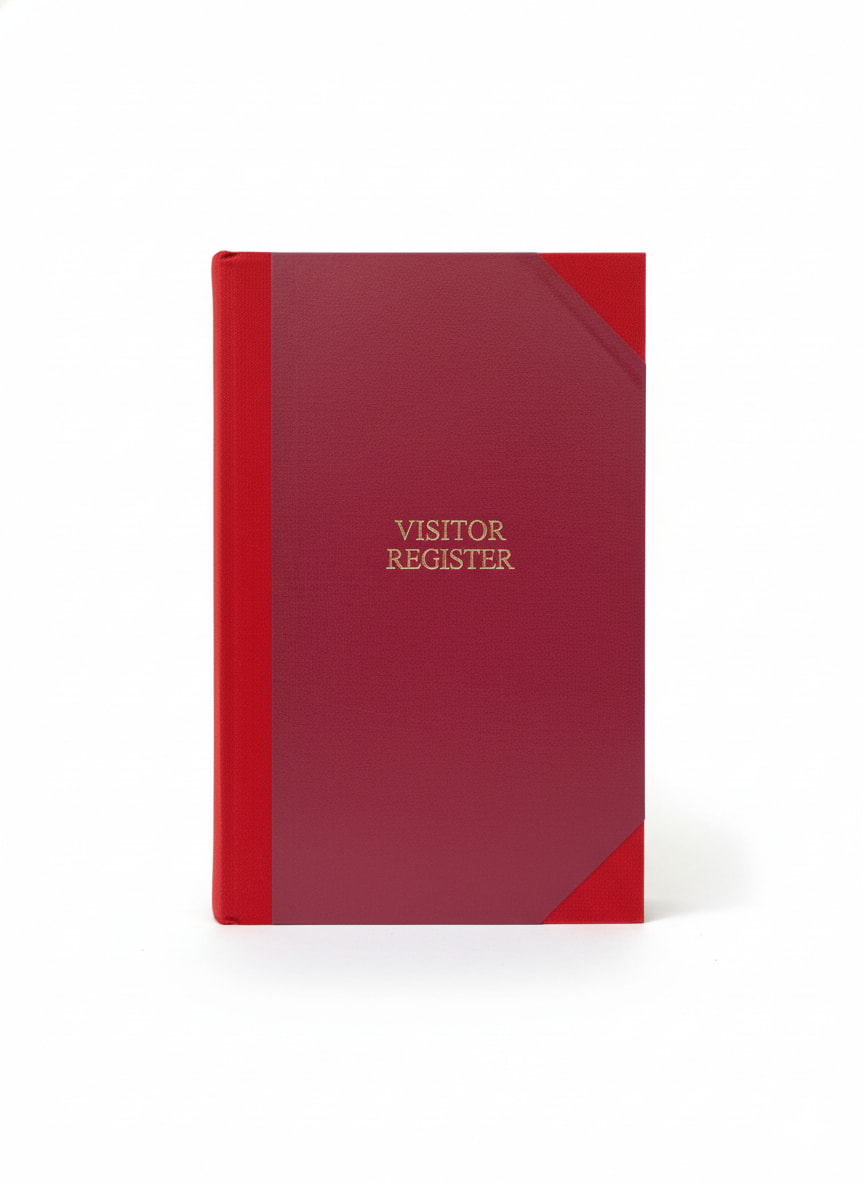
A visitor register is a record book kept at a reception desk, security gate or front office. Every visitor writes down their details when they arrive and signs out when they leave, creating a simple, dated record of all visits to a building.
Offices keep one to track meetings and deliveries and to know who is inside the building. Schools use it to record parents and suppliers, so children are handed over only to authorised people. Factories use it for safety: in an emergency, the register shows who is on site. Hospitals manage patient visitors with it, and housing societies record guests and delivery staff. It also helps later — if a parcel goes missing or a meeting time is disputed, the register gives a clear answer.
STANDARD VISITOR REGISTER FORMAT: WHAT EACH COLUMN MEANS
A standard visitor register format is a row of columns across a page. Each visitor takes one row, and each column asks for one detail. Keep the columns in the same order every day so staff and visitors can fill the register quickly.
| Column | What to write |
|---|---|
| S. No. | Serial number of the entry, in order from 1, continuing through the book. |
| Date | Date of the visit, written the same way every time, for example 22/11/2026. |
| Visitor Name | Full name, written clearly, in capital letters if possible. |
| Company / Organisation | Company or organisation the visitor represents; write “Personal” for a personal visit. |
| Address | Home or office address, or at least the area and street. |
| City | City the visitor has come from. |
| State | State of the visitor’s address. |
| Contact Number | Visitor’s mobile number — check it has the right number of digits. |
| Person to Meet | Employee, teacher, doctor or resident the visitor has come to meet. |
| Purpose of Visit | Reason for the visit in a few words, such as “Meeting” or “Delivery”. |
| Time In | Time the visitor entered, written as soon as they arrive. |
| Time Out | Time the visitor left; remind visitors to sign out before they leave. |
| Signature | Visitor’s signature, confirming the details in the row. |
| Remarks | Short, factual note, such as “ID checked” or “Visitor pass No. 12 issued”. |
VISITOR REGISTER FORMAT TABLE
The table below shows how these columns sit across a page. In a printed register, the columns are pre-printed, so every page looks the same.
| S. No. | Date | Visitor Name | Company / Organisation | Address | City | State | Contact Number | Person to Meet | Purpose of Visit | Time In | Time Out | Signature | Remarks |
|---|---|---|---|---|---|---|---|---|---|---|---|---|---|
| — | — | — | — | — | — | — | — | — | — | — | — | — | — |
If you have many visitors, use a wide, landscape register. A cramped page leads to small handwriting and skipped columns.

SAMPLE VISITOR REGISTER ENTRY
Here is a filled sample entry using the format above. The names, numbers and addresses below are fictional examples only.
| S. No. | Date | Visitor Name | Company / Organisation | Address | City | State | Contact Number | Person to Meet | Purpose of Visit | Time In | Time Out | Signature | Remarks |
|---|---|---|---|---|---|---|---|---|---|---|---|---|---|
| 1 | 22/11/2026 | Rahul Sharma | ABC Traders | 14, Market Road | New Delhi | Delhi | 98765 00000 | Anita Verma | Business meeting | 10:15 AM | 11:30 AM | R. Sharma | ID checked |
| 2 | 22/11/2026 | Priya Nair | City Supplies | 8, Station Road | Ghaziabad | Uttar Pradesh | 98765 11111 | Rohit Kumar | Delivery | 12:05 PM | 12:40 PM | P. Nair | Parcel received |
Notice that every column is filled. A complete entry takes less than a minute to write.
HOW TO MAINTAIN A VISITOR REGISTER AT RECEPTION OR GATE
1. Keep the register in one fixed place — on the reception counter or security desk, with a working pen attached.
2. Ask every visitor to fill it in on arrival, and confirm the person to meet while they write.
3. Check the entry before the visitor goes in — a quick glance catches a missing phone number.
4. Fill in Time Out at departure — ask visitors to sign out at the same desk.
5. Do not tear out pages. For a mistake, draw one line through it, write the correction beside it, and initial it.
6. Start a new book before the old one is full. Label the finished book with its date range and number the books.
7. Store finished registers safely in a dry cupboard, where only authorised staff can reach them.
WHO SHOULD USE WHICH FORMAT?
Most places can use the same standard format, but the emphasis changes with the setting.
Offices: Use the full format, with Company, Person to Meet and Purpose of Visit.
Schools: Focus on Visitor Name, Person to Meet, Purpose of Visit, and Time In and Time Out. Check ID for anyone collecting a child.
Factories: Keep the full format and add safety remarks, such as safety gear issued. Timings matter for headcounts in an emergency.
Hospitals: Use Visitor Name, Person to Meet, Purpose of Visit and timings, with remarks for the ward or visiting hours.
Housing societies: Focus on Visitor Name, Address, Contact Number, Person to Meet — the flat number — Purpose of Visit and timings.
COMMON MISTAKES TO AVOID
Leaving Time Out blank: Without a sign-out time, you cannot tell whether a visitor is still inside.
Unreadable handwriting: Ask visitors to write in capital letters. If you cannot read a name later, the entry has failed.
Skipping the phone number: This is the column most often left empty, and the one most needed later.
Using a different layout every day: Loose sheets make old records hard to search. Use one pre-printed book and one format.
Letting anyone take the book away: Keep it at the desk and store finished books safely.
FREQUENTLY ASKED QUESTIONS
WHAT IS THE FORMAT OF A VISITOR REGISTER BOOK?
A visitor register book format is a set of pre-printed columns across each page, with one row per visitor: S. No., Date, Visitor Name, Company or Organisation, Address, City, State, Contact Number, Person to Meet, Purpose of Visit, Time In, Time Out, Signature and Remarks.
WHAT DETAILS SHOULD A VISITOR ENTRY HAVE?
At minimum: the date, the visitor’s full name, contact number, the person to meet, the purpose of the visit, Time In and Time Out, and the visitor’s signature.
HOW LONG SHOULD VISITOR RECORDS BE KEPT?
There is no single rule for every organisation, so follow your organisation’s policy and any sector rules that apply. Many offices and schools keep finished registers for at least one year.
PAPER REGISTER OR DIGITAL REGISTER — WHICH IS BETTER?
A paper register is simple, needs no power or internet, and works at any gate or reception desk. A digital register can search records faster, but it needs a device, power and training.
START WITH A READY-MADE VISITOR REGISTER BOOK
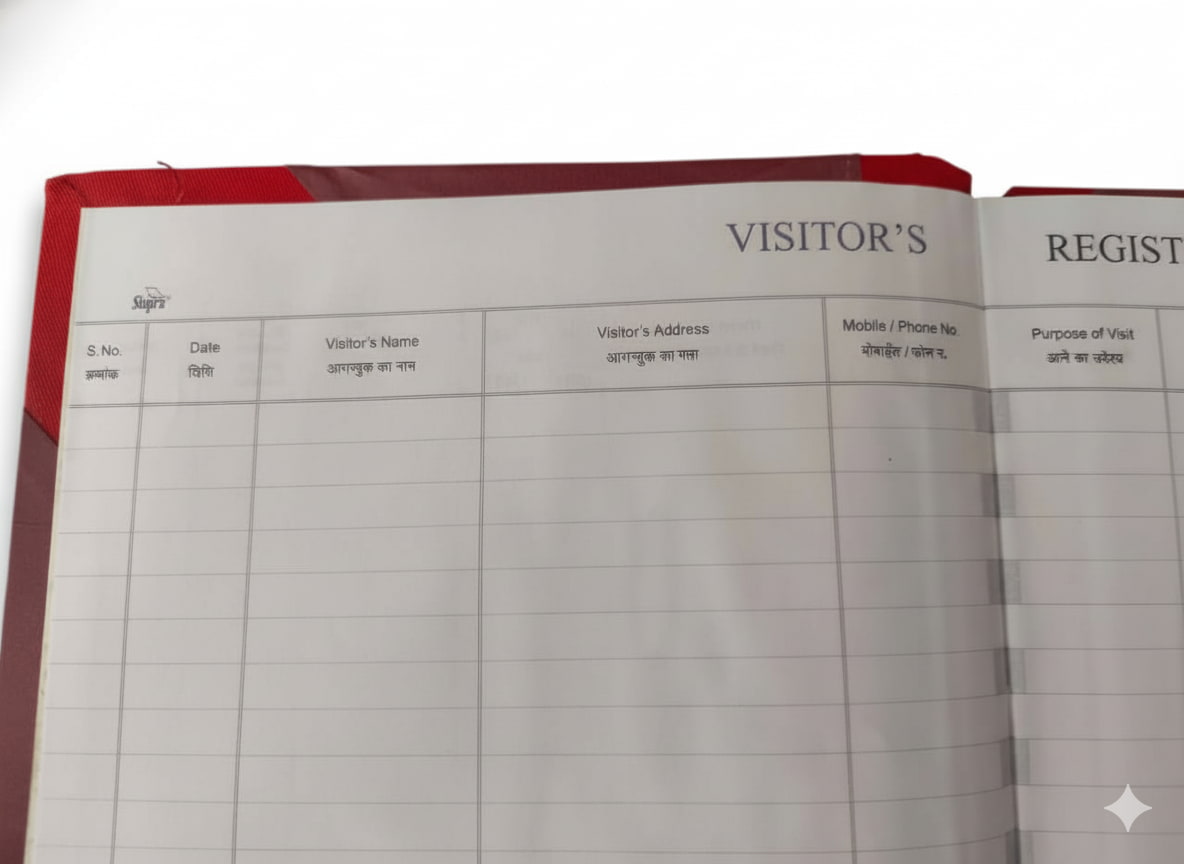
Setting up a good visitor register format is much easier when the columns are already printed for you. The ABHA PRINT visitor register book has pre-printed columns for Visitor name, Date, Company, Address, City and State. It is a hard bound book, 32 x 20 cm, with 100 pages of 70 GSM paper — a sturdy, practical choice for daily use at an office, school or factory reception desk.
Choose one format, use the same book every day, and keep your visitor records complete and easy to find. To get started, order the visitor register book from ABHA PRINT and put it on your reception desk today.